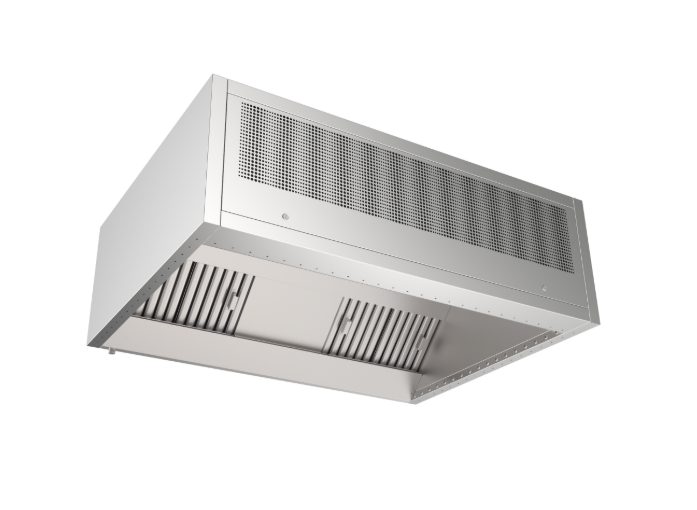
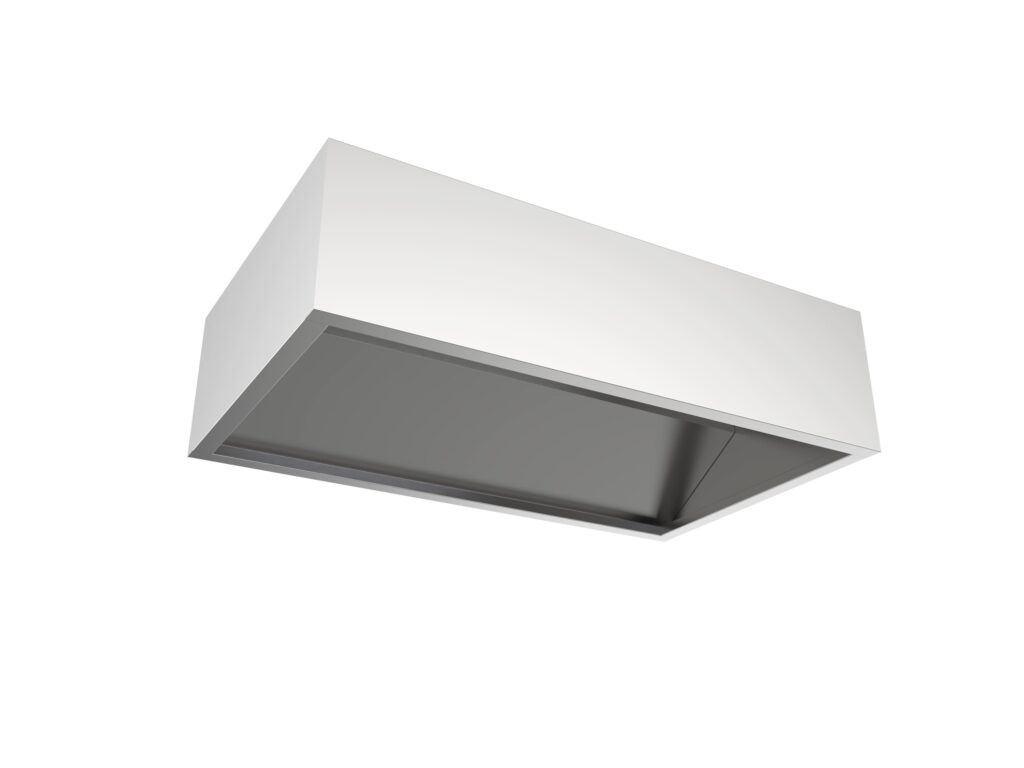
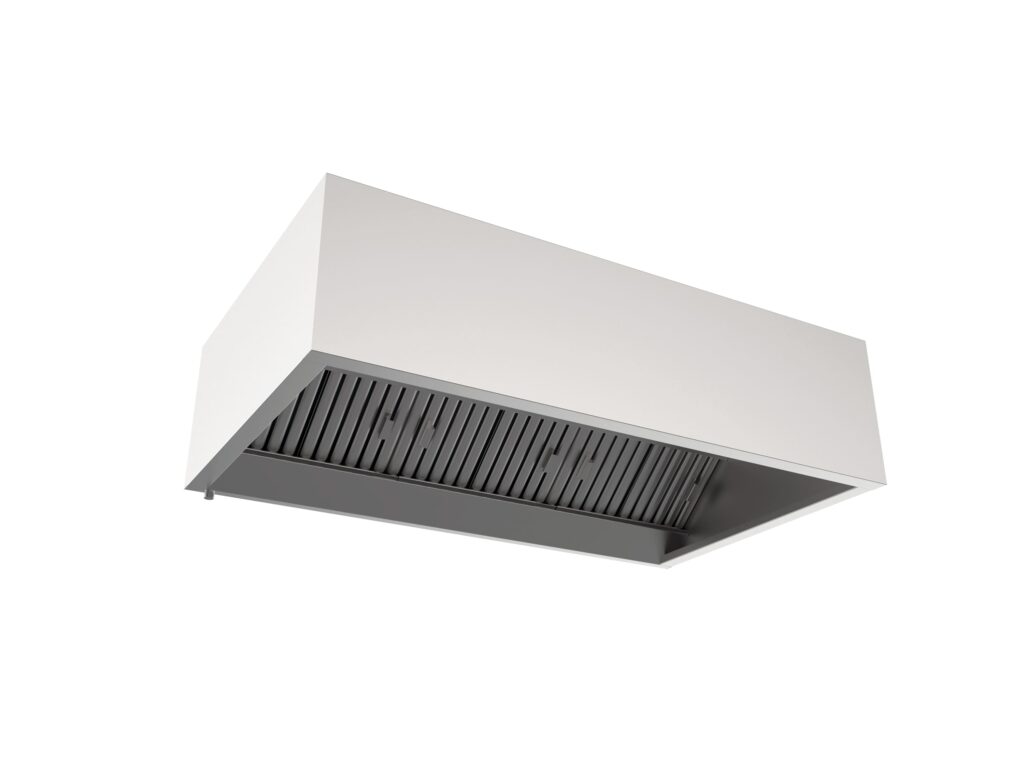
Industrial kitchen hoods for removing steam, grease and odours provide stable exhaust performance in hot commercial kitchens while protecting staff and equipment. They reduce the concentration of grease aerosols and cooking odours, minimise deposits inside ducts and help operators comply with hygiene and fire safety regulations in HoReCa and food production facilities. A well-designed kitchen ventilation system improves working conditions and extends the service life of ventilation equipment.
Key benefits:
Efficient removal of steam and grease — hoods capture hot, contaminated air directly above cooking appliances where steam and grease are generated.
Reduced odour transfer to guest areas — properly selected industrial kitchen hoods limit the spread of cooking odours to adjacent rooms and dining zones.
Fewer deposits inside ductwork — grease filters and cassette filters retain most grease particles at the hood, reducing the risk of duct blockage and fire.
Compliance with hygiene and fire codes — fire-resistant materials and certified filters support compliance with local hygiene and fire safety regulations.
Stable exhaust system operation — well-designed aerodynamics and robust fans ensure the required airflow even under continuous heavy-duty operation.
Improved working environment — lower temperature and humidity in the cooking area increase comfort and safety for kitchen staff.
Industrial kitchen hoods for removing steam, grease and odours are installed above ranges, fryers, grills and other cooking equipment. In operation, the hood creates a local capture zone that draws hot contaminated air into the canopy, passes it through grease filters and then into the exhaust duct system. This maintains the required air change rate and prevents overheating and smoke build-up in the kitchen.
Details:
Capture of contaminated air above cooking lines — the hood forms a capture area for steam, grease and smoke rising from cooking appliances.
Grease filtration — metal cassette or baffle filters separate grease from the air stream and drain condensate into dedicated collection trays.
Transport through ducts to the fan — air cleaned of coarse grease is conveyed through ducts to a roof or inline fan, which discharges it outdoors.
Coordination with supply ventilation — the exhaust system is balanced with supply air to maintain the correct pressure and avoid back-drafting.
Performance during peak load — industrial kitchen hoods are designed for intensive use during peak service periods without loss of extraction efficiency.
Easy cleaning and maintenance — filters and grease trays can be removed quickly for washing, simplifying regular cleaning and inspections.
When selecting industrial kitchen hoods for removing steam, grease and odours, it is essential to consider the type of cooking equipment, thermal load, kitchen layout and applicable fire safety regulations. Correct calculation of airflow and hood dimensions ensures effective contaminant capture without excessive energy consumption or draughts in the working zone.
What we consider when selecting:
Type and quantity of cooking equipment — ranges, fryers, grills, ovens and cooking lines all require different extraction rates and hood sizes.
Heat and moisture load — steam, grease and smoke generation is evaluated to determine the required airflow (m³/h) for each kitchen area.
Hood dimensions and mounting height — width, length and suspension height are selected to provide adequate capture area with safety margin.
Fire safety and code requirements — materials, filters and construction are chosen in line with local fire safety standards and grease duct cleaning regulations.
Integration with building ventilation — the operation of exhaust fans, supply units and smoke extraction systems is coordinated at design stage.
Serviceability and access — access to filters, grease trays and ducts is planned to allow regular cleaning, inspection and maintenance.

Quality and environmental management Vent System Project OÜ follows the principles of the ISO 9001 certificate.
Industrial (commercial) kitchen hoods are exhaust canopies designed for professional kitchens in restaurants, cafés, canteens and catering facilities. They are built for continuous operation, high airflows and large amounts of steam, grease and odours, usually made of stainless steel and equipped with grease filters. Domestic hoods are not designed for such loads and are not suitable for professional use.
They are used in restaurant kitchens, hotel kitchens, catering kitchens, canteens, food courts, bakeries and similar professional environments. The hoods are installed above cooking ranges, fryers, grills, ovens and other heat-producing equipment where significant amounts of steam, smoke and grease-laden air are generated.
Wall-mounted hoods are installed against a wall above a line of cooking equipment located along that wall. Island hoods are suspended from the ceiling above cooking equipment arranged in the centre of the kitchen. The choice depends on the kitchen layout and the position of the cooking lines.
The airflow depends on the type and quantity of cooking equipment, the size of the hood, the mounting height and the intensity of use. In practice, a designer or engineer calculates the required exhaust based on heat loads and equipment specifications. A correctly sized hood ensures effective capture of steam and grease without oversized air volumes and unnecessary energy consumption.
The hood is installed at a height that allows it to capture the rising thermal plume while still providing sufficient headroom for staff. The exact installation height depends on the hood design and the type of cooking equipment and is specified in the project and manufacturer’s instructions. Incorrect mounting height can significantly reduce capture efficiency.
Grease filters remove grease particles from the exhaust air before it enters the ductwork and fan. Labyrinth filters are shaped in such a way that grease separates and drains into collection channels while the air continues through the system. This reduces contamination of ducts, lowers fire risk and makes regular cleaning easier and more effective.
In many urban locations or where neighbours are close, additional odour and grease reduction systems — such as UV modules, ozone systems or activated carbon filters — are used. They help reduce odours and residual grease in the discharge air. Whether they are necessary depends on local requirements and the sensitivity of the surrounding environment.
Grease filters and internal hood surfaces should be cleaned at intervals that match the kitchen load — from several times per week to at least several times per month in busy kitchens. Ductwork and fans require regular inspections and periodic professional cleaning to maintain fire safety and stable airflow. The exact frequency is defined in the maintenance plan and operating procedures of the facility.
Price is influenced by hood size and type (wall-mounted or island), material, type and number of grease filters, additional options such as lighting and condensate channels, and any integrated odour reduction systems. Order volume and whether the hood is supplied as a standalone product or as part of a complete ventilation package also affect the total cost.
Industrial kitchen hoods can be supplied as individual items for existing designs or as part of complete commercial kitchen ventilation systems, including ductwork, fans and additional filtration or odour reduction modules. Bundling the hood and ventilation components into one solution helps ensure compatibility and reliable operation for projects in Estonia and, where required, in Latvia and Lithuania.
VENT SYSTEM PROJECT OÜ (11720522), Ida-Viru County, Narva City, Narva, Oru tn 4, 20203
VENT SYSTEM PROJECT OÜ (11720522), Ida-Viru County, Narva City, Narva, Oru tn 4, 20203